
- Mobile 4G/5G carrier IPs
- Bandwidth rolls over, never expires
- EWDCI-certified ethical sourcing
- ISP, carrier & ZIP targeting
- Same price as Webshare, more included
- 80M+ residential IPs
- 10 proxies free, no card
- Datacenter IPs from $0.018
- Static residential from $0.23/IP
- $1.40/GB at 3,000 GB
The short version: Pricing is identical at every shared tier — $3.50/GB at 1 GB, $1.50/GB at 1 TB. For the same money ProxyEmpire adds mobile carrier IPs, bandwidth that never expires and certified ethical sourcing. Webshare adds a free tier and cheap datacenter IPs.
Who each provider is built for
Different companies, different bets
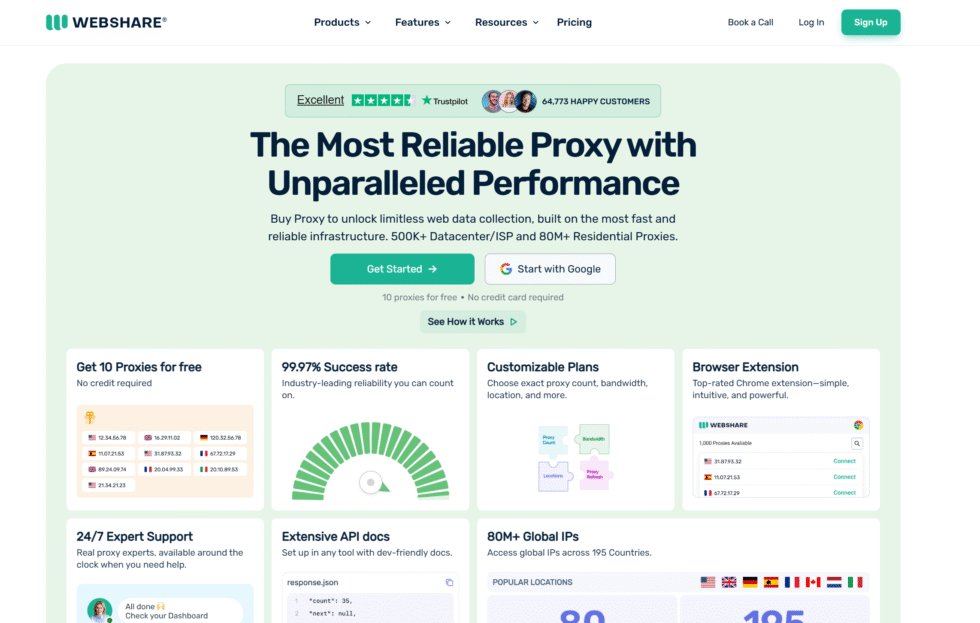
Webshare
Webshare competes on price and self-service. The product is designed so a developer can sign up, take ten free proxies, and be running inside a few minutes without speaking to anyone. The catalogue is broad on the fixed-line side — rotating residential, static residential in private and dedicated flavours, and a large datacenter pool from $0.018 per IP — and the pricing is published openly, which is more than many competitors manage.
The trade-off is depth in the places that need a human: there is no mobile product, no published rollover policy, and no third-party sourcing certification. For a solo developer scraping public data at volume, none of that is likely to matter. For a compliance-reviewed procurement process, all three will come up.
ProxyEmpire
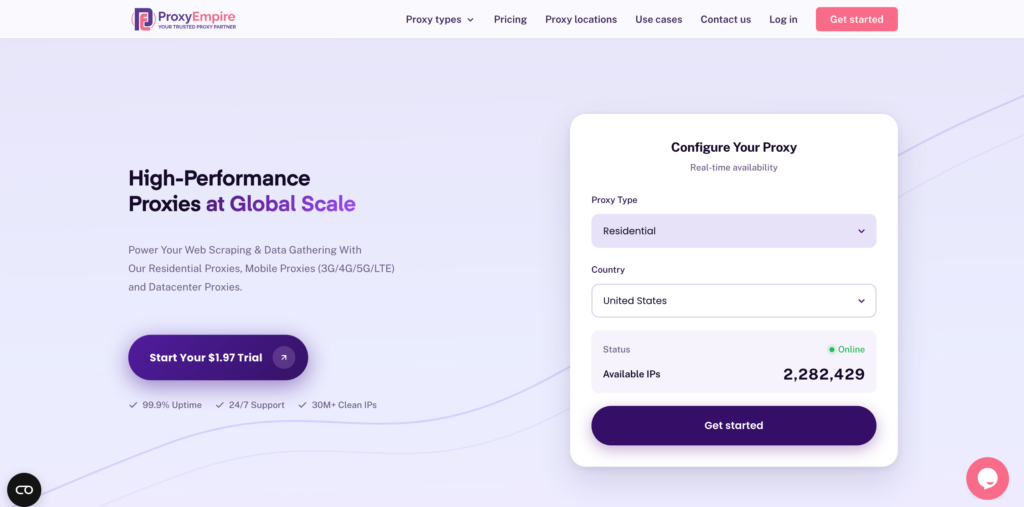
We built around a different bet: that the hard part of proxy work is not acquiring bandwidth cheaply but getting a session that survives contact with a defended target, and being able to explain where the IP came from when someone asks. That shapes the product — mobile carriers alongside fixed lines, ISP-level targeting, sessions that stay sticky when you need them to, bandwidth that does not evaporate, and a sourcing chain that has been reviewed by someone other than us.
We are an aggregator rather than a single network. We combine supply from multiple vetted providers, which is how we reach coverage a single pool cannot and keep a country online when one supplier degrades. It also means compliance is the thing we select suppliers on, because the model only works if the supply is clean.
Side-by-side, with sources
Every figure sourced and linked · verified 1 September 2026
Comparison pages usually quote whichever numbers flatter the author. Below, every claim about Webshare comes from Webshare’s own website on the date shown, and every claim about ProxyEmpire comes from our published pricing or our live targeting API. Where Webshare is better, the table says so.
| Feature | ProxyEmpire | Webshare |
|---|---|---|
| Mobile proxies (4G/5G carrier IPs) | Yes — rotating and dedicated | Not offered |
| Bandwidth rollover | Yes — unused GB never expires | Not stated |
| Ethical sourcing certification | EWDCI certified | Not stated |
| Named ISP targeting | Yes — by ISP and mobile carrier | Via ASN |
| Price for 1 GB | $3.50 — or $1.97 on trial | $3.50 |
| Concurrent sessions | Unlimited on approved use cases | Not stated |
| Support | 24/7 human, dedicated managers on larger accounts | 24/7 support |
| Geo-targeting | Country, region, city, ZIP, ISP, mobile carrier | Country, city, state, ZIP, ASN |
| Published uptime | 99.9% | 99.7% |
| Rate at 1 TB | $1.50/GB | $1.50/GB |
| Residential pool | 30M+ IPs, 170+ countries | 80M+ IPs, 195+ locations |
| Free tier | No — $1.97 trial | 10 proxies free |
All figures verified 1 September 2026. Webshare figures from webshare.io and its pricing and residential proxy pages. ProxyEmpire figures from our pricing page and live targeting API on the same date. Prices change — check both before deciding.
What each provider actually costs
Reading past the headline rate
Here is the part most comparison pages get wrong: the two providers charge almost exactly the same money. Not approximately — identically, at most tiers.
| Volume | ProxyEmpire | Webshare | Difference |
|---|---|---|---|
| 1 GB | $3.50/GB | $3.50/GB | Identical — and our trial gigabyte is $1.97. |
| ~50–60 GB | $2.50/GB at 60 GB | $2.45/GB at 50 GB | Within five cents. |
| ~250–315 GB | $1.98/GB at 315 GB | $2.00/GB at 250 GB | Marginally cheaper, on more bandwidth. |
| 500 GB | $1.75/GB | $1.75/GB | Identical. |
| 1,000 GB | $1.50/GB | $1.50/GB | Identical. |
| 3,000 GB | Contact us | $1.40/GB | Their published ceiling; we quote at that scale. |
So price is not the question. At 1 GB, 500 GB and 1 TB the two providers charge the same rate to the cent. If cost per gigabyte is your only criterion this is a coin toss, and you should decide on something else. That something else is the rest of this page: we include mobile carrier IPs, bandwidth that rolls over instead of expiring, ISP and carrier targeting, and third-party certified sourcing. Webshare includes none of those. Same money, more product.
Where Webshare fits better
Where we would not pretend otherwise
A comparison that finds no merit in the competitor is marketing, not analysis. Two areas where Webshare is the better pick:
A published price above 1 TB
Their table runs to 3,000 GB at $1.40/GB. Ours stops at 1,000 GB and we quote beyond that. If you want a fixed public number at 3 TB rather than a conversation, they have one and we do not.
Very large single-country pools
80 million residential IPs is a larger footprint than our 30 million. If your work needs enormous IP diversity within one country, or coverage somewhere we do not reach, the bigger pool matters. For most workloads the constraint is session quality and targeting rather than raw pool size, but where it is volume, they have more of it.
Free tier and cheap datacenter proxies
Ten free proxies with no card is a genuinely low-friction way to start, and datacenter IPs from $0.018 each are hard to beat for tasks that do not need residential authenticity. Our entry point is a $1.97 trial, which is cheap but not free.
Our honest position: if the above describes your project, use Webshare. We would rather you pick the right tool than churn after a month. The rest of this page explains the cases where the answer is different.
Where ProxyEmpire is the better choice
Three things Webshare does not publish
Mobile proxies
Webshare’s product line covers rotating residential, static residential and datacenter. Mobile — real 4G and 5G carrier IPs — is not among them. We run a mobile network, and it is targetable to individual carriers. In the United States that means Verizon Wireless, AT&T Wireless, T-Mobile USA, UScellular, Boost Mobile, C Spire, Optimum Mobile and others; in smaller markets it means the one or two national carriers that exist.
This matters because carrier IPs are scored differently by anti-bot systems. Traffic arriving on a mobile ASN, behind carrier-grade NAT shared by thousands of real subscribers, is far harder to treat as suspicious than traffic on a fixed line. For social platforms and mobile-first targets it is often the difference between working and not. See rotating mobile proxies.
Bandwidth that does not expire
Our unused gigabytes roll over. Webshare’s pricing page does not mention rollover. That sounds like a minor billing detail until a project pauses for a month, or a client delays sign-off, and you discover the bandwidth you paid for has gone. On a 500 GB plan, a single idle month is real money.
This also changes the price comparison. A cheaper per-GB rate on bandwidth that expires is not straightforwardly cheaper than a higher rate on bandwidth that does not — the honest calculation depends on how evenly you consume it.
Certified ethical sourcing
We work as an aggregator: rather than running one network, we combine supply from vetted providers, and compliance is what we select on. Every provider must show that the people whose connections carry the traffic opted in, are compensated and can leave at any time. Our sourcing is certified by the Ethical Web Data Collection Initiative, which reviews how a provider acquires IPs and how consent is obtained.
Webshare’s pricing page references a fair usage policy but states no sourcing certification. If your legal or procurement team asks where the IP addresses come from — and in regulated industries they will — a third-party certification is an answer. Read more about how we source.
Targeting: closer than most comparisons admit
Correcting a common claim
Both services reach comparable geographic precision. The differences sit at the edges, and they are the ones worth knowing:
The real difference is narrower and worth stating precisely:
| Targeting dimension | ProxyEmpire | Webshare |
|---|---|---|
| Country | Yes | Yes |
| Region / state | Yes | Yes |
| City | Yes | Yes |
| ZIP / postcode | Yes | Yes |
| ASN | Yes | Yes |
| Named ISP | Yes | Via ASN |
| Mobile carrier | Yes | Not applicable — no mobile product |
Both services reach ZIP-code precision. The difference is at the edges: we can pin a session to a named ISP or a specific mobile carrier, which Webshare cannot, because they have no mobile product. Our targeting is queryable through the same API our dashboard uses, so the available regions, cities, ISPs and carriers for any country can be read directly rather than taken on trust — see any of our location pages for what that looks like in practice.
Protocols, integration and day-to-day use
The parts you live with
Both providers speak the protocols that matter. Webshare publishes HTTP and SOCKS5 support; we support HTTP, HTTPS and SOCKS5. In practice, any tool that can take a proxy string — a browser automation framework, a scraping library, an anti-detect browser, a commercial SEO tool — will work with either service, because both use standard username-and-password authentication over a gateway host.
The differences show up in the details of a working day rather than in a feature matrix:
Session control
Rotating sessions suit stateless work: fetch a page, parse it, discard the IP. The moment a task involves a login, a shopping basket or a multi-step form, you need the IP to hold still. Both providers offer sticky sessions; the question worth testing is how long they actually hold under load on your target, which no comparison page can answer for you.
Getting the credentials right
Both services build targeting into the username string, so a single gateway endpoint serves every country and every session type. That is convenient, and it is also the most common source of confusion for new users — a mistyped parameter fails open to a different country rather than throwing an error. Test a handful of requests and confirm the exit IP before scaling. Our proxy checker reports country, ISP and anonymity level for any proxy, whoever sold it to you.
Support when something breaks
Both providers advertise round-the-clock support. The meaningful question is what happens on the third message, when the easy answers have not worked and someone needs to look at your actual traffic. We staff human support and assign dedicated managers on larger accounts. We would encourage you to test this the same way you test anything else — open a ticket with a hard question before you commit budget, and see what comes back.
Which should you choose
By use case
| If your priority is… | Pick | Why |
|---|---|---|
| Social platforms, app testing, mobile-first targets | ProxyEmpire | Webshare has no mobile product. Carrier IPs sit behind carrier-grade NAT shared with thousands of real subscribers, and are scored far more leniently. |
| Projects that start and stop, or client work with delays | ProxyEmpire | Rollover means a paused month does not burn the budget. On a 500 GB plan one idle month can exceed the per-GB gap entirely. |
| Procurement or legal review of IP sourcing | ProxyEmpire | EWDCI certification is a third-party answer to “where do these addresses come from”. Webshare states none. |
| Pinning traffic to a named ISP or carrier | ProxyEmpire | ISP and carrier targeting, readable from the live API rather than taken on trust. |
| Trying residential proxies for under $2 | ProxyEmpire | Our trial gigabyte is $1.97; their smallest plan is $3.50. |
| Sessions that must survive a login or checkout | ProxyEmpire | Sticky sessions plus unlimited concurrency on approved use cases. |
| A published price above 1 TB a month | Webshare | Their table lists 3,000 GB at $1.40/GB; we quote at that scale rather than publish. |
| Cheap datacenter IPs at scale, or spending nothing to test | Webshare | From $0.018/IP, and ten proxies free with no card. |
| Best value per gigabyte overall | ProxyEmpire | Same rate as Webshare at every shared tier, but the gigabyte includes mobile, rollover and ISP targeting. |
A note on how we wrote this. Every Webshare figure here was read from Webshare’s own website and is linked above, so you can confirm each one yourself. We have not quoted a competitor statistic we could not find on their site. Prices and pool sizes on both sides change — re-check before you commit.
How we verified this comparison
Our method, so you can check it
This page is published by ProxyEmpire, so you should read our conclusions with that in mind. What we can offer instead of asking for trust is a method you can repeat.
| Claim type | How it was established |
|---|---|
| Webshare pricing and pool size | Read directly from webshare.io, its pricing page and its residential proxy page on 1 September 2026. Each is linked above so you can confirm the figure yourself. |
| Webshare product line | Taken from the products listed on their pricing page. Where something is absent — mobile proxies, rollover, sourcing certification — we say “not offered” or “not stated” rather than asserting it does not exist. |
| ProxyEmpire pricing | Our published list pricing, linked. Promotional rates are frequently lower; we quote list so the comparison stays like-for-like. |
| ProxyEmpire targeting | Read from the live targeting API that powers our dashboard, on the same date. Country, region, city, ISP and carrier lists are queryable rather than asserted. |
| Ethical sourcing | EWDCI certification, linked to the initiative’s own member page rather than to a badge on our site. |
Two rules we applied while writing. First, no statistic appears here unless we could point at its source — which is why you will not find a claim about how many IPs Webshare has in a specific country, or a market-size figure for the proxy industry. Second, where the honest answer favours the competitor, the page says so; the tables above mark the rows where Webshare wins, and a whole section explains when to choose them.
If you find something on this page that is out of date or wrong, tell us and we will correct it. That includes claims in our favour.
Frequently asked questions
Is Webshare cheaper than ProxyEmpire?
No — the pricing is identical at every tier both providers publish. Both charge $3.50/GB at 1 GB, $1.75/GB at 500 GB and $1.50/GB at 1,000 GB. Their table extends to 3,000 GB at $1.40/GB, where we quote instead. Since the money is the same, the question is what the gigabyte includes: ours covers mobile carrier IPs, rollover and ISP targeting; theirs does not.
Does Webshare offer mobile proxies?
Not as of 1 September 2026. Their published product line is rotating residential, static residential and datacenter proxies. If you need 4G or 5G carrier IPs, that is a genuine gap.
Who has the bigger network?
Webshare, on published figures — 80 million residential IPs across 195+ locations against our 30 million across 170+ countries. Pool size is not the only measure that matters, but on that measure they are larger.
Does Webshare offer city-level targeting?
Yes, and so do we. Both services reach country, city, state and ZIP-level precision. Where we go further is named ISP and mobile carrier targeting — Webshare has no mobile product, so carrier targeting is not available there at all.
What is bandwidth rollover and why does it matter?
Unused gigabytes carry into the following month instead of expiring. It matters most for uneven workloads — agency work, seasonal projects, anything that pauses. On a large plan, one idle month of expired bandwidth can exceed the price difference between providers.
What does EWDCI certification actually mean?
The Ethical Web Data Collection Initiative reviews how a provider acquires its IP addresses, how consent is obtained from the people sharing their connection, and how those people can leave the network. It is a third-party check rather than a self-declaration, which is why we point to it instead of simply asserting good practice.
Can I use both providers?
Many teams do, and it is often the sensible answer. Cheap datacenter or bulk residential from one provider for volume work, mobile or ISP-targeted sessions from another for the jobs that need them. Nothing about either service requires exclusivity.
How do I test the difference myself?
Run the same target through both. Our free proxy checker reports country, ISP and anonymity level for any proxy, including ones you did not buy from us. A gigabyte on our $1.97 trial is enough to compare success rates on your own target rather than trusting either provider’s marketing.
Test both on your own target before deciding. A gigabyte costs $1.97, unused bandwidth rolls over, and if Webshare turns out to fit your job better, that is a good outcome too.