
Korean proxies are essential tools for privacy, accessing geo-restricted content, and optimizing business operations like web scraping or ad verification. For those targeting South Korea or requiring South Korean IPs, selecting the right proxy service can make all the difference. Here’s a detailed guide to the top 11 Korean proxy services in 2026, tailored for various use cases and budgets.
🇰🇷 Start your $1.97 Trial 🇰🇷
Learn more about ProxyEmpire’s South Korea Residential Proxies
What to Look for in a Korean Proxy Service
Before diving into the list, let’s outline key factors to consider when choosing a proxy provider:
- IP Pool Size: A larger pool ensures better anonymity and fewer chances of IP bans.
- Targeting Options: Country, city, or ISP-level targeting is crucial for precise operations.
- Connection Speed: Faster proxies reduce latency and improve efficiency.
- Reliability: High uptime (over 99%) ensures uninterrupted service.
- Pricing: Flexible plans that suit your usage needs without hidden fees.
Top 11 Korean Proxy Services
1. 🏆 ProxyEmpire 🏆 – Best 🇰🇷South Korea Proxy Providers for 2026 🇰🇷

ProxyEmpire is a premium proxy service provider designed to empower web scraping, data collection, and unrestricted internet access through a vast network of ethically sourced residential, mobile, and datacenter proxies. Below is a detailed description based on the provided information:
Overview of ProxyEmpire
ProxyEmpire offers a comprehensive suite of proxy solutions tailored for individuals, businesses, and developers seeking reliable, high-performance tools for data gathering and privacy protection. With over 30 million clean IP addresses spanning 170+ countries, ProxyEmpire provides unparalleled global coverage, ensuring users can access content at scale with a 99.9% uptime and lightning-fast response times (as low as 0.6 seconds).
Proxy Types and Features:
🏘️ Rotating Residential Proxies
Key Benefits
- Global Reach: Access to over 30 million IPs worldwide, covering every major region, with precise targeting options (country, city, state, ASN/ISP).
- High Reliability: A 99.86% uptime ensures uninterrupted service, supported by patented technology for enhanced speed and security.
- Ethical Sourcing: Proxies are responsibly harvested, ensuring quality and compliance.
- Versatile Use Cases: Supports web scraping, price monitoring, sneaker copping, SEO tracking, ad verification, and more.
- Integration-Friendly: Compatible with standard proxy protocols (HTTP, SOCKS5) and third-party tools like Multilogin, Dolphin Anty, Kameleo, Octobrowser, and Gologin.
- No Hidden Fees: Transparent pricing with all features included, starting at a $1.97 trial.
Use case:
2. Oxylabs

Oxylabs boasts an impressive 1.3 million South Korean IPs with AI-powered routing and city-level targeting. Their enterprise-grade infrastructure ensures seamless data collection.
- Key Features:
- 99.95% uptime.
- Advanced ISP targeting.
- Best For: Enterprise-level data scraping and market research.
3. ResiProx
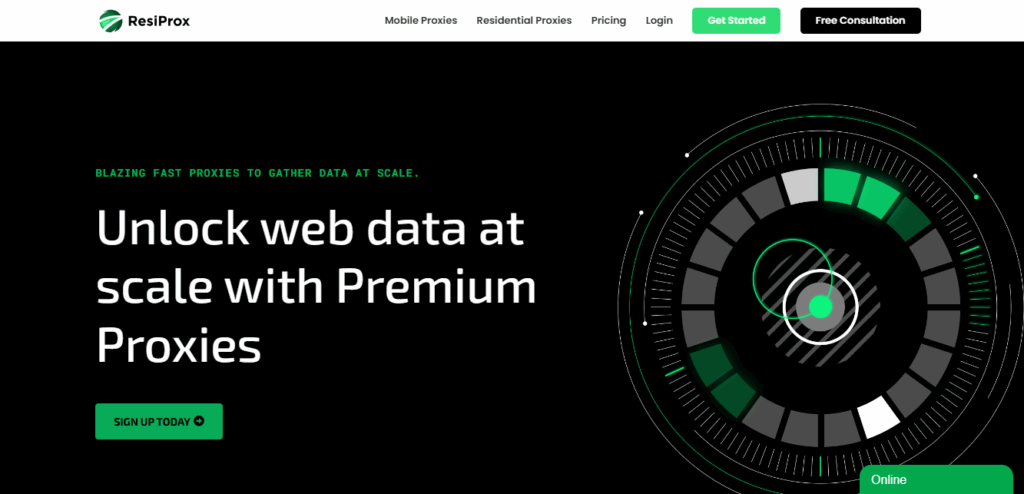
ResiProx provides proxy options suited for tasks requiring connections from South Korea, including residential and mobile varieties for various online activities. Their services support protocols that ensure compatibility with different applications, making them applicable for data gathering and account management in Korean digital spaces.
- Key Features:
- Rotating residential and mobile proxies for dynamic IP management and sustained access
- Support for HTTPS and SOCKS5 protocols ensuring compatibility with various applications
- Best For: Data gathering, web scraping, and automation in Korean digital environments
4. SmartProxy

SmartProxy offers over 58,000 South Korean IPs, making it a great choice for startups and small businesses. Their pay-as-you-go plans are budget-friendly.
- Key Features:
- Rotating residential proxies with dynamic IPs.
- User-friendly dashboard.
- Best For: Social media management and localized SEO.
5. SOAX

SOAX provides flexible proxy session controls with over 72,000 South Korean IPs. Their intuitive dashboard simplifies proxy management.
- Key Features:
- Granular geo-targeting options.
- Rotating and static IPs.
- Best For: Ad verification and gaming optimization.
6. IPRoyal

IPRoyal offers a robust network of over 370,000 South Korean IPs, emphasizing ethical sourcing and high reliability.
- Key Features:
- Static and rotating proxy options.
- Uptime of 99.9%.
- Best For: Market analysis and content access.
7. NetNut

NetNut connects directly to ISPs, providing over 175,000 South Korean residential IPs with zero throttling.
- Key Features:
- Consistent static proxies.
- High-speed connections.
- Best For: E-commerce price monitoring and stable scraping tasks.
8. Bright Data

Bright Data is known for its vast global network, including South Korea. They offer customizable solutions for businesses of all sizes.
- Key Features:
- Comprehensive API integration.
- Flexible pricing tiers.
- Best For: Large-scale data collection projects.
9. StormProxies

StormProxies is an affordable option for those needing basic proxy services in South Korea.
- Key Features:
- Simple setup process.
- Rotating residential proxies.
- Best For: Beginners and small-scale projects.
10. Webshare
Webshare, headquartered in San Mateo, California, USA, provides Korean proxies that deliver fast, reliable, and secure connections for users requiring South Korean IPs. The service supports a vast global network, enabling efficient geo-targeting for activities such as web scraping, social media management, and bypassing restrictions. Its strengths include scalable pools and customizable concurrency, allowing high-thread operations without interruptions. However, while it offers strong performance, the focus on country-level targeting may restrict precision in localized tasks within Korea. Overall, Webshare stands out for its balance of speed and stability, though optimal use requires careful configuration to maximize effectiveness in diverse scenarios.
- Key features: Residential and datacenter proxies, country-level targeting, HTTP and SOCKS5 protocol support, rotating and dedicated options for flexible usage.
- Accurate data and information: High uptime ensuring consistent availability, low latency for quick responses, customizable concurrency supporting 500-3000 threads simultaneously.
- Market insights: Total proxy pool exceeding 80 million IPs globally, ideal for large-scale automation and data collection with broad international coverage.
11. Rayobyte
Rayobyte, based in Lincoln, Nebraska, USA, offers premium South Korean proxies emphasizing ethical sourcing and authenticity for seamless data access. The provider maintains the largest residential pool in South Korea, facilitating undetectable scraping and secure browsing across various applications. Strengths encompass high success rates and a wide distribution of IPs, enhancing reliability for competitive intelligence and automation. Weaknesses may arise from the focused ethical approach, potentially constraining volume compared to less regulated alternatives. Nevertheless, Rayobyte excels in delivering robust, unblockable connections, making it a solid choice for users prioritizing quality and compliance in their operations.
- Key features: Residential and mobile proxies, ethically sourced authentic IPs, real mobile IPs from South Korean networks with nationwide dispersion.
- Accurate data and information: 99.99% success rates in Korea, capable of handling over 5 million requests daily with consistent performance.
- Market insights: Extensive pool for South Korea, supporting stealthy data scraping in critical sectors like healthcare and e-commerce with high-quality, verifiable IPs.
Why Use a Korean Proxy Service?
Using a reliable Korean proxy service can unlock several benefits:
- Access geo-restricted content like streaming platforms or local websites.
- Conduct market research by simulating local user behavior in South Korea.
- Scrape localized data without getting flagged as suspicious activity.
- Manage multiple social media accounts from different locations seamlessly.
How to Choose the Right Provider
When selecting a proxy service, consider your specific needs:
- If you need high scalability for large-scale data scraping, go with providers like ProxyEmpire or Oxylabs.
- For budget-friendly options with moderate features, SmartProxy or StormProxies are ideal choices.
- If ethical sourcing is a priority, IPRoyal stands out as a responsible provider.
The right proxy service can significantly enhance your online operations by providing secure, reliable access to South Korean IPs. Whether you’re managing social media accounts or conducting advanced market research, there’s a provider on this list tailored to your needs.
🇰🇷 Start your $1.97 Trial 🇰🇷
Proxy Protocols Explained: HTTP vs SOCKS5
Proxy protocols serve as the foundation for how connections are managed in various online activities. HTTP proxies handle web traffic efficiently, making them suitable for tasks where only browser-based interactions are needed. Users turn to HTTP proxies in situations requiring straightforward request handling without additional overhead. On the other hand, SOCKS5 proxies support a wider range of applications, including those beyond simple web requests, by managing data at a lower level. This flexibility leads people to select SOCKS5 proxies when dealing with diverse protocols in their setups. Integrating these with rotating residential proxies allows for dynamic IP management during sessions that demand frequent changes to maintain performance. Similarly, static residential proxies pair well with protocols needing stable, unchanging connections over extended periods.
Integrating Proxies with Automation Tools
Automation tools streamline repetitive tasks, and proxies enhance their functionality by providing varied connection points. When setting up scripts for data collection, incorporating rotating mobile proxies ensures that the automation mimics natural patterns from different devices. Developers often choose dedicated mobile proxies in scenarios where exclusive access to a single IP is necessary for consistent tool performance.
For basic learning, the web scraping 101 resource outlines how proxies fit into automation frameworks. In account management contexts, social media proxies integrate seamlessly with tools designed for handling multiple profiles. Additionally, proxies for ad verification become integral when automation involves checking display elements across various sessions.
Latest News In 2026
As the year progresses, the dynamic IP proxy service market in South Korea shows continued expansion, influenced by rising needs for reliable online connections. Recent policy updates from advisory firms have introduced changes affecting how proxy evaluations occur, with implications for service providers adapting to new standards. In corporate sectors, revisions to commercial acts are prompting adjustments in proxy-related practices, particularly around director appointments and shareholder engagements.
Meanwhile, advancements in Asia-focused proxy networks highlight improvements in speed and security, with providers emphasizing specialized pools in regions like Japan and South Korea. These developments underscore a shift toward more robust proxy infrastructures supporting activities such as e-commerce monitoring and data gathering.
Latest News In 2025
In 2025, proxy services in South Korea have expanded their role in supporting online streaming platforms, enabling smoother content delivery across networks. The gaming sector has integrated these services more deeply to optimize connection stability during multiplayer sessions. E-commerce applications have adopted proxy technologies to streamline inventory tracking and market analysis processes. Regulatory frameworks continue to adapt, focusing on enhancing data protection measures within digital environments.
FAQ
What Are Korean Proxy Services?
Korean proxy services act as intermediaries between users and the internet, routing requests through servers located in South Korea. This setup allows for interactions with online resources as if originating from within the country.
How Do Korean Proxies Work?
Korean proxies function by receiving user requests and forwarding them to the target website using a South Korean IP address. The response is then sent back through the proxy, maintaining the connection flow. This process involves protocols like HTTP or SOCKS5 for compatibility.
What Types of Korean Proxies Exist?
Several types of Korean proxies are available, including those sourced from real devices for everyday use and dedicated ones for consistent access. Mobile-based options offer connectivity through cellular networks, while datacenter variants provide high-speed alternatives.
What Benefits Do Korean Proxies Offer?
Using Korean proxies can enhance online activities by providing access to region-specific content and supporting tasks like market research. They help in managing multiple connections efficiently and ensure smoother browsing experiences.
How Can Korean Proxies Be Used for Web Scraping?
Korean proxies facilitate web scraping by allowing data collection from South Korean websites without direct exposure. They support tools that extract information from search engines or social platforms. An example includes using a scraping API for Naver to gather insights from Korea’s popular search engine.
Are Korean Proxies Secure for Online Activities?
Korean proxies contribute to security by masking the user’s original IP address, adding a layer of protection during internet sessions. Features like encryption protocols further safeguard data transmission.
What Is the Difference Between Residential and Datacenter Korean Proxies?
Residential Korean proxies come from actual household connections, offering authenticity, whereas datacenter ones are hosted on servers in data centers for faster performance. Each type suits different scenarios based on requirements.
How to Set Up a Korean Proxy?
Setting up a Korean proxy involves configuring the proxy details in your browser or application settings, entering the IP address and port provided. Some services offer extensions or apps for easier integration.
What Are Common Applications for Korean Proxies?
Common applications include accessing Korean social media, conducting competitive analysis, and testing website functionality from a local perspective. They are useful for developers and researchers handling region-focused projects.
Can Korean Proxies Support Multiple Devices?
Korean proxies can be configured to support multiple devices simultaneously, depending on the service’s capabilities. This allows for shared usage across computers, smartphones, or other gadgets.
What defines a Korean proxy service?
A Korean proxy service involves intermediaries that route internet traffic through servers associated with South Korea, facilitating connections that appear local to that area. These services come in various forms, including those using residential IPs sourced from real users or datacenter options from server farms. Providers typically offer features like IP rotation to switch addresses periodically, which helps in maintaining uninterrupted access during prolonged usage. Compatibility with different protocols ensures they work with a range of software and applications.
How do proxies function in online environments?
Proxies act as gateways between a user’s device and the internet, forwarding requests and responses while masking the original IP address. This process begins when a request is sent to the proxy server, which then communicates with the target site on behalf of the user. Responses travel back through the same path, allowing for added layers of anonymity. In practice, this setup supports tasks where multiple requests are made, as the proxy can distribute them across different IPs to avoid detection.
What distinguishes residential proxies from datacenter proxies?
Residential proxies utilize IPs assigned by internet service providers to actual households, making them appear as genuine user connections. People opt for residential proxies in cases where authenticity is key, such as in scenarios requiring trust from target systems. Datacenter proxies, sourced from cloud servers, offer higher speeds due to their dedicated infrastructure. Users select datacenter proxies when prioritizing quick response times over realism in their operations.
In what ways do mobile proxies differ from other types?
Mobile proxies leverage IPs from cellular networks, simulating connections from smartphones or tablets. This type is chosen when applications involve mobile-specific behaviors, like app testing or dynamic content loading. Rotating versions of mobile proxies cycle through IPs to refresh connections, while dedicated ones provide a fixed IP for exclusive use. Their structure aligns with 4G or 5G networks, offering variability that desktop-based proxies might lack.
How does IP rotation impact proxy usage?
IP rotation refers to the automatic switching of IP addresses at set intervals or after certain actions. This mechanism is built into many services to distribute traffic and reduce the risk of blocks from overuse of a single IP. Services incorporating rotation, such as those detailed in rotating datacenter proxies explanations, allow for sustained operations in high-volume tasks. Without rotation, sessions might face interruptions, leading users to prefer rotating options for efficiency.
What role do proxies play in data scraping?
Proxies enable data scraping by providing multiple entry points to websites, allowing tools to collect information without triggering anti-scraping measures. In scraping setups, a pool of IPs ensures requests come from varied sources, mimicking organic traffic. Advanced configurations might combine proxies with headers and delays to further enhance success rates. This approach is common in market analysis or content aggregation, where large datasets are extracted systematically.
Why might someone use proxies for social media management?
Proxies assist in social media management by enabling the operation of multiple accounts from a single device without raising flags. Each account can route through a different IP, creating the illusion of separate users. This is particularly useful for marketing or monitoring purposes, where handling numerous profiles is required. Services focused on this, as covered in relevant resources, outline integration methods with platform APIs.
How are proxies applied in ad verification processes?
In ad verification, proxies confirm that advertisements display correctly by simulating views from different connections. This helps detect issues like fraud or improper placement. By routing checks through varied IPs, verifiers gather accurate data on ad performance across networks. The process involves scripting or tools that automate these views, ensuring comprehensive coverage.
What considerations arise when selecting proxy bandwidth?
Bandwidth in proxies determines how much data can be transferred, affecting speed and capacity for concurrent tasks. Unlimited options are favored for heavy usage, while metered plans suit lighter needs. Factors like the number of threads in automation influence bandwidth requirements, with higher demands leading to selections of robust services.
How do proxies support e-commerce activities?
Proxies aid e-commerce by allowing price monitoring or inventory checks through multiple IPs, preventing blocks from repeated accesses. This enables real-time data on product availability and pricing fluctuations. In competitive environments, such as limited releases, proxies facilitate faster responses by distributing requests.
Learn more about ProxyEmpire’s South Korea Residential Proxies