Proxifier is a desktop proxy client for Windows and macOS, with an Android app, that sends the traffic of programs with no proxy settings of their own through a SOCKS5 or HTTPS proxy. This guide covers what it is and what it costs on the day, how to add a ProxyEmpire rotating residential proxy under Profile → Proxy Servers, how proxification rules decide which apps use it, DNS through the proxy, sticky and rotating sessions, proxy chains, testing, troubleshooting, and how it compares with a system proxy and a browser extension. Every menu name was checked against the vendor’s documentation.
The short version
Open Profile → Proxy Servers → Add, enter v2.proxyempire.io, port 5000, protocol SOCKS Version 5 (or HTTPS) with your ProxyEmpire username and password, click Check, then say Yes to using it by default or write a rule under Profile → Proxification Rules for the apps you want proxied. Turn on Resolve hostnames through proxy under Profile → Name Resolution if DNS should follow the proxy too. Session behaviour lives in the username: a session ID keeps one IP, and a new ID gets a new one.
What Proxifier is, versions and pricing
A proxy client, not a proxy networkMany programs can’t use a proxy at all: games, database clients, mail apps, command-line tools, older desktop software. The vendor’s documentation describes the app as a way to let such programs work through a SOCKS or HTTPS proxy, or a chain of proxies, without changing their configuration. It sits in the operating system’s network stack, catches outgoing TCP connections, and hands each one to the proxy that its rules pick. You can tunnel every TCP connection on the machine or only the ones you choose.
It doesn’t supply IP addresses. The vendor’s own FAQ says it only provides the software, not proxy accounts. The host, port, username and password come from your proxy provider, and the app routes traffic to them.
Platforms and current versions
The download page on 1 October 2026 listed three products. There is no Linux version.
| Edition | Version and date | Runs on |
|---|---|---|
| Windows Standard Edition v4 | 4.14, 23 April 2025 | Windows 7, 8, 10 and 11 and Server 2008 to 2022, on x86, x64 and ARM. Installed, needs admin rights. |
| Windows Portable Edition v4 | 4.14, 23 April 2025 | The same Windows versions on x86 and x64. No installation, runs from a folder or USB stick. |
| Mac v3 | 3.15, 18 September 2025 | macOS 12 to 26. |
| Android | 1.18, 15 April 2025 | Android 8 and later, from Google Play. The vendor says some desktop features aren’t there yet. |
Version 4 for Windows has a rewritten network engine based on Windows Filtering Platform (WFP), Microsoft’s current way of handling traffic. The vendor says this lets it handle Windows Store apps, Windows Subsystem for Linux and shared folders, and reduces conflicts with antivirus software. The Mac v3 engine moved to Apple’s Network Extension framework, which is why it needs a recent macOS.
Standard or Portable
Both Windows editions support the same protocols, rules and DNS options, and their profiles are interchangeable. The Portable Edition can only handle applications with a graphical interface: it can’t proxy Windows services, console programs or other users’ sessions, and it can’t start with Windows. If you want a command-line scraper or a background service behind the proxy, use the Standard Edition.
Pricing
| Licence | Price (1 copy) | Notes |
|---|---|---|
| Windows Standard v4 | $39.95 | Installed; also covers services and console programs |
| Windows Portable v4 | $39.95 | No installation; programs with a window only |
| Mac v3 | $39.95 | macOS 12 to 26 |
| Android | Free trial, then in-app purchase | Through Google Play; the price shows for your country |
The desktop licences are a one-time payment for a perpetual licence with free minor updates (for example 4.00 to 4.99), and one licence allows one running instance at a time. Volume pricing falls from $34.99 each for 2 copies to $24.99 each from 100, and the vendor offers a 30-day money-back guarantee. Every desktop edition runs for 31 days as a free trial with no feature limits; it only shows a reminder window on start-up. Windows and Mac need separate licences. Owners of older versions get an upgrade discount, and anyone who bought Windows v3 on or after 1 July 2020 upgrades to v4 free.
Adding a ProxyEmpire proxy under Profile → Proxy Servers
One server entry, four fieldsBefore you start, switch off any proxy you set inside the apps themselves and any system-wide proxy. The documentation warns that otherwise a connection may be proxied twice, once by the app and once by the client. The same goes for a VPN on the same machine: two routing layers make results hard to read.
Get your details from the ProxyEmpire dashboard. Open Proxy Manager, go to the Connection Builder, pick Residential or Mobile, choose the location and rotation, and copy the username. Residential and mobile proxies use one gateway: host v2.proxyempire.io, port 5000, for both HTTP and SOCKS5, with the same username and password. ProxyEmpire authenticates by username and password only; there is no IP whitelist to set up.
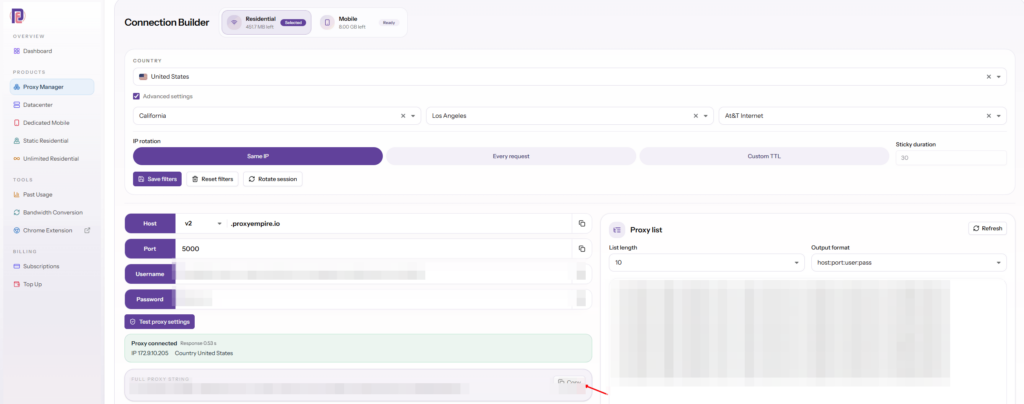
Then, on Windows or Mac:
- Choose Profile → Proxy Servers, or the matching toolbar icon.
- Click Add.
- Fill in the form as in Figure 1, then click Check to run the built-in Proxy Checker (Windows only).
- Click OK. The app asks whether to use this proxy by default. Yes makes it the action of the Default rule, so every connection goes through it. No keeps it in the list for rules you write yourself.
Address   v2.proxyempire.io
Port      5000
Protocol  SOCKS Version 5          (or HTTPS)

Authentication
  Username  YOUR_USERNAME-country-us-sid-123456   (copied from the Connection Builder)
  Password  YOUR_PASSWORD

Advanced...  -> Custom Label: PE-US-sticky-1   (optional, shown in rules and logs)
SOCKS Version 5 or HTTPS?
The Protocol list offers four choices, and the names mean something specific here:
- SOCKS Version 5 carries any TCP connection and supports a username and password (RFC 1929). This is the best default for a desktop client that proxies games, mail, SSH or scripts as well as browsers. Our SOCKS proxy guide explains the protocol.
- HTTPS means an HTTP proxy that supports the CONNECT method on any port, which the documentation also calls a CONNECT or SSL proxy. It is not a TLS-encrypted link to the proxy. ProxyEmpire’s gateway handles CONNECT, so this works too.
- HTTP is hidden by default and can only carry plain HTTP connections. You have to enable it at Profile → Advanced → HTTP Proxy Servers. You don’t need it for ProxyEmpire.
- SOCKS Version 4 is a legacy protocol with no password support, so it won’t work with a username and password login.
For HTTPS entries, the documentation lists NTLM, Kerberos and “use current user login” options for corporate proxies. Leave them off: ProxyEmpire uses a plain username and password. Our comparison of SOCKS vs HTTP proxies covers when each protocol is the better fit.
Two ProxyEmpire limits apply whichever protocol you pick. Only target ports 80 and 443 are open by default, so a game server or mail server on another port won’t connect through the proxy. And there is no UDP: the client only tunnels TCP anyway, so plan for web traffic, which is what residential and mobile IPs are for.
Proxification rules: which apps use the proxy
Top to bottom, first match winsA proxy in the list does nothing until a rule points at it. Proxifier checks every new connection against these rules. Open Profile → Proxification Rules. Each profile starts with two built-in rules:
- Localhost keeps loopback connections (127.0.0.1) off the proxy. Keep it enabled; the documentation notes that apps such as Firefox depend on local connections.
- Default sits at the bottom and catches every connection no other rule matched. You can only change its action.
Click Add to write a rule. The rule window has these fields:
| Field | What to put in it |
|---|---|
| Name | Anything meaningful, such as “Scraper via US residential”. |
| Applications | Executable names, with or without a path, separated by semicolons: chrome.exe; "my tool.exe". Wildcards * and ? work, and so does pid=1234. Browse picks a file (the + button on Mac). |
| Target hosts | Hostnames or IP addresses, separated by semicolons: *.example.com; 10.0.0.1-10.0.0.255. IPv4 CIDR such as 192.168.0.0/16 works on Windows. Leave empty for any host. |
| Target ports | Ports or ranges: 80; 443. Leave empty for any port. |
| Action | Proxy (a server), Chain (a proxy chain), Direct (no proxy) or Block. |
A connection has to match all three criteria, applications, hosts and ports, for a rule to apply, and an empty field matches everything. Rules are read from the top down, and the first match wins, so put the most specific rules at the top and move them with the arrow buttons. Untick a rule to switch it off without deleting it.
#  Rule name               Applications          Target hosts                  Action
1  Localhost (built-in)    Any                   loopback (127.0.0.1)          Direct
2  Local network           Any                   192.168.*.*; 10.*.*.*; *.lan  Direct
3  Research browser        chrome.exe            Any                           Proxy SOCKS5 v2.proxyempire.io:5000
4  Price checker           pricebot.exe          *.example-shop.com            Proxy PE-US-sticky-1
5  Block updater leaks     updater.exe           Any                           Block
6  Default (built-in)      Any                   Any                           Direct
Setting Default to Direct, as above, is the safe pattern: only the apps you name use paid bandwidth, and Windows Update, cloud sync and chat stay on your own connection. Set Default to the proxy only when you really want the whole machine behind it. A Direct rule for your private address ranges keeps printers, network drives and office servers reachable either way.
Applications are matched by the process that opens the connection. Many programs start helper processes, and browsers run several at once, so name the process that actually connects. The connection list shows it. On Mac v3, rules and the connection list show app identifiers, such as Safari, rather than internal helper names.
Manual proxification and background services
The Windows Standard Edition adds a submenu to the right-click menu of .exe files. Starting a program from there sends that one instance through the proxy or chain you pick and ignores all rules for it. It’s handy for a quick test, but a launcher that starts a second program only passes the setting to the first.
Services and programs run by other Windows users aren’t handled by default. The Standard Edition can take them over at Profile → Advanced → Services and Other Users, which the documentation marks as an option for advanced users.
DNS through the proxy: Profile → Name Resolution
Where hostnames get looked upA rule sends the TCP connection through the proxy, but the hostname lookup before it is a separate step. By default your own DNS resolver answers it, so your provider’s resolver sees every site you visit, and a site that answers DNS differently by region gives you your local answer, not the one for the proxy’s country.
Open Profile → Name Resolution. The default mode is Detect DNS settings automatically, which only switches to proxy resolution when your system DNS stops working. To make lookups follow the proxy all the time, turn the automatic mode off and tick Resolve hostnames through proxy. The client then passes the hostname to the proxy and the ProxyEmpire gateway resolves it on its side.
The documentation is frank about the trade-offs. Because no real IP address comes back, the app hands the program a placeholder address valid only on your computer, and rules based on IP addresses stop matching. Write rules with hostnames instead. The name list under the option lets you keep some names local. Do NOT resolve the following resolves the listed names locally and everything else through the proxy. Resolve ONLY the following does the reverse. The %SimpleHostnames% entry covers dot-less local names such as nas, and %ComputerName% covers your own machine.
DNS settings worth knowing
- The bottom of the main window shows which DNS mode is active.
- Windows 4.11 added Profile → Advanced → DNS and IP Leak Prevention Mode, a master switch for the leak-prevention settings, and an option to block non-A/AAAA DNS queries when DNS goes through the proxy.
- If you keep local DNS, the Advanced button on a proxy entry has “Use target hostname in proxy request if available”, which sends the hostname rather than the IP to the proxy when the program connected by name.
- With Log → Screen Log set to Verbose, DNS requests appear in the output.
Sticky and rotating sessions through the username
The app forwards the username; the gateway decides the IPProxifier has no rotation setting of its own. It opens each connection with the username you typed, and ProxyEmpire’s gateway decides which exit IP that connection gets. In the Connection Builder you choose one of three modes:
- Same IP: a sticky session. The IP stays until you rotate it or the device behind it goes offline, with no fixed time limit.
- Every request: each new connection gets a different IP.
- Custom TTL: the IP changes on a timer you set, up to two hours.
ProxyEmpire’s documentation says each sticky session carries a session ID, sid, in the proxy username. The samples on ProxyEmpire’s product pages use the form YOUR_USERNAME-country-us-sid-123456, where country-us selects the United States and sid-123456 holds the session. Copy the full username from the Connection Builder rather than typing it, since your targeting choices change it. Our guide to sticky vs rotating proxies explains which suits which job.
This matters more here than in a browser extension, because the client proxies each TCP connection on its own. A browser loading one page opens many connections, so with Every request the page’s parts can come from different IPs, and a login can drop halfway. Use Same IP for anything with a session: logins, checkouts, dashboards, app testing. Use Every request for tools that fetch many independent pages.
Proxy Servers (all v2.proxyempire.io:5000, SOCKS Version 5, same password)
  Label          Username
  PE-US-1        YOUR_USERNAME-country-us-sid-100001
  PE-US-2        YOUR_USERNAME-country-us-sid-100002
  PE-DE-1        YOUR_USERNAME-country-de-sid-200001

Rules:  browser-a.exe -> PE-US-1   |   browser-b.exe -> PE-US-2   |   qa-tool.exe -> PE-DE-1
To run several sticky IPs at once, add the gateway several times with a different session ID in each username, give each a Custom Label under Advanced, and point different rules at them. To get a fresh IP for one entry, change its session ID or use Rotate session in the ProxyEmpire dashboard.
Proxy chains, failover and load balancing
Several proxy entries working as oneA proxy chain sends a connection through two or more proxies in order. In Profile → Proxy Servers, add the proxies, click Proxy Chains if the chains area is hidden, click Create, and drag proxies from the list into the chain. Connections pass through them from top to bottom. Then set a rule’s action to Chain. The documentation lists the conditions: a chain can mix SOCKS v4, SOCKS v5 and HTTPS proxies, an HTTP proxy can only be the last hop, the whole chain fails if one proxy fails, and every hop adds its latency.
The usual reason to chain with ProxyEmpire is a network that only lets you out through a company proxy: that proxy goes first and the ProxyEmpire gateway last, as the exit the website sees. Most people don’t need a chain at all. Our explainer on proxy chaining covers how chains work and when they are worth the speed cost.
The Type button turns a chain into something else:
- Simple Chain (default): proxies in sequence, as above.
- Redundancy: failover. If the first proxy fails, the next one takes over without the program noticing. The Options button sets the timeout and has “Connect directly if all proxies fail”. Leave that off if the goal is never to show your own IP.
- Load Balancing: each connection goes through a random proxy in the chain. Tick “Use the same proxy for the same process PID” and each running program keeps one proxy. Fill such a chain with the sticky entries from Figure 3, and each program gets its own steady IP.
Testing the setup
Check the proxy, then check the route- Check the server. The Check button in the Proxy Server dialog opens Proxy Checker. It tests the connection, the login and a web request, reports problems with suggested fixes, and measures latency. Test Settings sets the target host and port; keep the target on port 80 or 443 for ProxyEmpire. You can also open it from View → Proxy Checker. The Mac documentation lists Proxy Checker as Windows-only, so on a Mac go straight to step 2.
- Check the exit IP. Open an IP-check page in the program your rule covers. It should show the proxy’s IP and country, not yours. With a sticky username, reload a few times and the IP should stay the same. With Every request it should change.
- Check the rule. The Connections pane lists each connection with its application, target, status and a Rule : Proxy column showing which rule matched and which proxy it used. “Direct” there means the connection skipped the proxy.
- Read the log. Set Log → Screen Log to Verbose to see rule matching and DNS requests, or Debug when you are chasing an error. Write it to a file with Log → File Log.
A green check proves the proxy works. Only the connection list proves your app is using it.
Once it works, save the setup. File → Save Profile As stores it under a name, and File → Export Profile writes a .ppx file (plain XML) you can load on another machine; profiles move between the Windows and Mac versions. Proxy passwords in a profile can be encrypted with your Windows account or a master password under Profile → Advanced → Password Encryption.
Troubleshooting
Symptom, likely cause, fix| Symptom | Likely cause | Fix |
|---|---|---|
| Proxy Checker fails although the password is right | Wrong protocol or port, or an HTTP proxy without CONNECT support entered as HTTPS | Use SOCKS Version 5 or HTTPS on port 5000 with host v2.proxyempire.io. The documentation names missing CONNECT support as the usual cause of HTTPS failures. |
| Authentication fails | Username typed by hand, missing its targeting part, or an old session ID | Copy the username and password again from the Connection Builder. The proxy’s Advanced settings can ask for the login interactively when it fails. |
| The app still shows Direct | A rule higher up matched first, the wrong .exe is named, or a helper process makes the connection | Read the process name in the connection list, put it in the rule, and move the rule above wider ones. |
| Traffic goes through two proxies | The program also has its own proxy setting | Set the program to connect directly and let the client do the proxying. |
| A service or console tool isn’t proxied | Portable Edition, or services not enabled | Use the Standard Edition and enable Profile → Advanced → Services and Other Users. |
| IP-based rules stopped matching | Resolve hostnames through proxy is on, so programs get placeholder IPs | Write those rules with hostnames. |
| “Infinite loop connection detected” | A VPN, antivirus or other local proxy is re-proxying its own traffic | Add a Direct rule for that program. Loop detection lives at Profile → Advanced → Infinite Connection Loop Detection. |
| Some sites or servers never connect | A target port other than 80 or 443, or UDP traffic | ProxyEmpire opens only ports 80 and 443 by default and carries no UDP. Browsers use QUIC over UDP for some sites; blocking UDP 443 normally makes them fall back to TCP. |
| Bank or payment sites refuse to load | Blocked on ProxyEmpire | Financial, government, crypto and payment sites are blocked on all proxy types; unblocking needs KYC and a use-case review. |
| The IP changes during a login | Every request rotation | Switch to Same IP, or use a load-balancing chain with the same-PID option. |
On UDP: Windows 4.11 added the ability to log and block UDP connections, and Mac 3.6 added an option to block UDP port 443, the port QUIC uses. Blocking QUIC is useful when you need a browser’s traffic to stay on the proxy, since UDP isn’t tunnelled.
Proxifier vs a system proxy vs a browser extension
Three ways to put an app behind a proxy| Desktop proxy client | System proxy setting | Browser extension | |
|---|---|---|---|
| What it covers | Any TCP program, chosen by rules | Only programs that read the setting | One browser |
| Username and password | Yes, SOCKS5 and HTTPS | Windows’ manual setup asks for address and port only | Depends on the extension |
| Per-app rules | Yes, plus host and port rules | No | Per-site rules in many extensions |
| DNS through the proxy | Yes, Name Resolution | Up to each program | Up to the browser and protocol |
| Cost | $39.95 after a 31-day trial | Free, built in | Usually free |
A system proxy is the setting in Windows under Settings → Network & internet → Proxy, or in macOS network settings. It is a request that apps may follow or ignore, and Microsoft’s instructions for Windows’ manual setup ask only for the address, port and exceptions, with no field for a login. That makes it a poor fit for a username and password proxy.
A browser extension controls the proxy of one browser through the browser’s proxy API. It is the lightest option when the browser is all you need to proxy, and it can switch proxies per site. ProxyEmpire has its own Chrome extension, ProxyEmpire Proxy Manager, which manages ProxyEmpire proxies in regular Chrome. On Android, the free ProxyEmpire Proxy Manager app routes all apps or chosen apps through HTTP CONNECT or SOCKS5 without root; our Android proxy guide walks through it.
A desktop proxy client is the right tool when programs without proxy settings must use a proxy, when different programs need different IPs, or when DNS must follow the proxy. For a wider look at managing many proxies, see our overview of what a proxy manager does.
FAQ
Short answersWhat is Proxifier used for?
Sending programs that have no proxy settings, such as games, mail clients, database tools and scripts, through a SOCKS5 or HTTPS proxy, and choosing per app, host or port which connections use which proxy.
Is Proxifier free?
The desktop editions are free for a 31-day trial with no feature limits. After that a perpetual licence costs $39.95 for Windows Standard, Windows Portable or Mac. The Android app has a free trial and an in-app purchase.
Is there a Proxifier for Linux?
No. The vendor lists Windows, macOS and Android only. On Linux, proxychains-ng or a program’s own proxy settings do a similar job.
Is Proxifier safe, and does it encrypt traffic?
It is commercial software from VentoByte, and the vendor says all its binaries are signed with an EV code-signing certificate. It installs a network driver on Windows and a network extension on macOS, which is how it sees connections. It routes connections to a proxy but doesn’t encrypt them like a VPN. The link to a SOCKS5 or HTTPS (CONNECT) proxy isn’t encrypted, but connections to HTTPS websites stay encrypted end to end through it.
Does it proxy UDP?
No. It tunnels TCP connections. Windows 4.11 and later can log and block UDP, and the Mac app can block UDP port 443 so browsers fall back to TCP.
Should I choose SOCKS5 or HTTPS for ProxyEmpire?
SOCKS Version 5 is the better default for a desktop client because it carries any TCP connection. HTTPS, which in this app means an HTTP CONNECT proxy, works too, on the same host, port and login.
Can the app rotate IPs by itself?
No. Rotation happens at the ProxyEmpire gateway and is set in the username. A load-balancing chain can spread connections across several proxy entries.
Why do some apps ignore my rule?
Usually a helper process makes the connection, a higher rule matches first, or the Portable Edition can’t handle that type of program. The connection list shows which process and rule each connection used.
References
Primary documentation, read 1 October 2026- Proxifier documentation, Windows v4 — Proxy Server Settings. docs/win-v4/proxy.html
- Windows v4 — Proxification Rules. docs/win-v4/rules.html
- Windows v4 — Name Resolution. docs/win-v4/dns.html
- Windows v4 — Proxy Chains. docs/win-v4/chain.html
- Windows v4 — Proxy Server Redundancy (failover and load balancing). docs/win-v4/redundancy.html
- Windows v4 — Editions (Standard vs Portable). docs/win-v4/editions.html
- Mac v2 documentation, which the Mac v3 docs refer to for day-to-day use. docs/mac-v2
- Downloads: versions, dates and system requirements. download
- Prices and licence terms. buy
- Windows v4 changelog (UDP blocking and DNS leak prevention in 4.11). changelog
- Microsoft — Use a proxy server in Windows. support.microsoft.com
- Chrome for Developers — chrome.proxy extension API. developer.chrome.com/docs/extensions/reference/api/proxy
- ProxyEmpire — How to use proxy sticky sessions. proxyempire.io/docs/how-to-use-proxy-sticky-sessions
- ProxyEmpire Proxy Manager — Chrome Web Store. chromewebstore.google.com
- ProxyEmpire Proxy Manager — Google Play. play.google.com
Put Proxifier on a residential IP for $1.97
One gateway for residential and mobile proxies over SOCKS5 and HTTP: 30M+ residential IPs in 179 countries and territories and 4M+ mobile IPs in 174 countries, with city, ZIP, ISP and ASN targeting at no extra charge, sticky or rotating sessions, 99.9% uptime and 24/7 support from real people. The trial includes 100 MB of residential and 50 MB of mobile traffic.