Whether you are tracking rankings on Naver and Google.co.kr, monitoring prices on Coupang, Gmarket and 11st or verifying the ads Korean users see, a Korean proxy is the only way to see the country as local users do. To find the best South Korea proxies, and the best Korean proxy for each job, we compared 15 Korean proxy services on what matters here: which types each South Korea proxy provider actually publishes, how precisely you can target inside the country, and what you pay.
Quick answer
ProxyEmpire is the best South Korea proxy provider in 2026. It sells all four products locally — residential, mobile, datacenter and static — and publishes its Korean coverage in detail: all 17 provinces and metropolitan cities, 172 locations, 15+ fixed-line ISPs and mobile IPs on SK Telecom, KT and LG U+. All targeting is included at no extra cost, residential starts at $1.50/GB, and a trial costs $1.97.
Best South Korea proxies compared
All 15 providers at a glance| # | Provider | Korean proxy types | South Korea targeting | Residential price | Best for |
|---|---|---|---|---|---|
| 1 | ProxyEmpire | Residential, mobile, datacenter, static | 17 regions, 172 locations, 15+ ISPs, 3 carriers, ASN | $3.50 → $1.50/GB | Best overall in South Korea |
| 2 | IPRoyal | Residential, ISP, datacenter, mobile | City (around 80 listed) | $7.00 → $3.36/GB | Cities outside Seoul |
| 3 | ResiProx | Rotating residential, rotating mobile | Country, region, city, ISP | $3.50 → $1.75/GB | ISP targeting on a budget |
| 4 | Oxylabs | Residential, mobile, dedicated datacenter | Country, state, city, ASN | $6.00 → $2.50/GB | Enterprise-scale scraping |
| 5 | Proxy-Seller | Residential, mobile, ISP, IPv4, IPv6, datacenter | City (none named) | $3.50 → $1.45/GB | Cheapest at 1 TB |
| 6 | Byteful | Residential, mobile, static ISP, datacenter | Region, city, ISP, carrier, ASN | $3.25 → $1.95/GB | Non-expiring traffic |
| 7 | NodeMaven | Residential, mobile | Region, city, ISP | $5.31 → $2.75/GB | IP-quality filtering |
| 8 | SOAX | Residential, mobile | Region, city, carrier | $5.00 → $1.50/GB | Carrier-level targeting |
| 9 | Bright Data | Residential, mobile, ISP, datacenter | City, state, ZIP | $8.00 → $5.00/GB | ZIP-level targeting |
| 10 | Webshare | Datacenter, static residential, rotating residential | Country, city, state, ZIP, ASN | $3.50 → $1.50/GB | Cheap datacenter IPs |
| 11 | Infatica | Residential, mobile, datacenter, static ISP | Country, city (12 named), ZIP | $4.00 → $2.60/GB | Seoul’s satellite cities |
| 12 | MarsProxies | Residential, ISP, datacenter, mobile | City (4 listed) | $4.99 → $2.10/GB | Four proxy types in one plan |
| 13 | Decodo | Residential | Country (no Korean city named) | $4.00 → $2.00/GB | Pay-as-you-go residential |
| 14 | IPBurger | Residential (listed, no Korea page) | Country, city | $5.90 → $4.48/GB | Monthly team plans |
| 15 | ProxyRack | Residential (listed, type not stated) | Country | $1.10 → $0.80/GB | High-volume residential |
The price column shows each provider’s regular list rate on its smallest residential plan, then the lowest per-GB rate it publishes at 1 TB or less. Rates needing multi-terabyte commitments are excluded, and promotions are covered in the reviews instead. These are global prices. All South Korea coverage figures were read from each provider’s own site on 25 September 2026.
How we compared Korean proxy services
What separates providers in South KoreaEvery provider here sells Korean proxies; the question is how much you know before you pay. Published pool figures run from 5,000+ to 2,421,601 for the same country, only seven of the 15 name any Korean city, and only two name the mobile networks they use. Korean sites check the network behind a visit, so documented ISP and carrier targeting counted for more than pool size.
The 15 best Korean proxy providers in 2026
Detailed reviews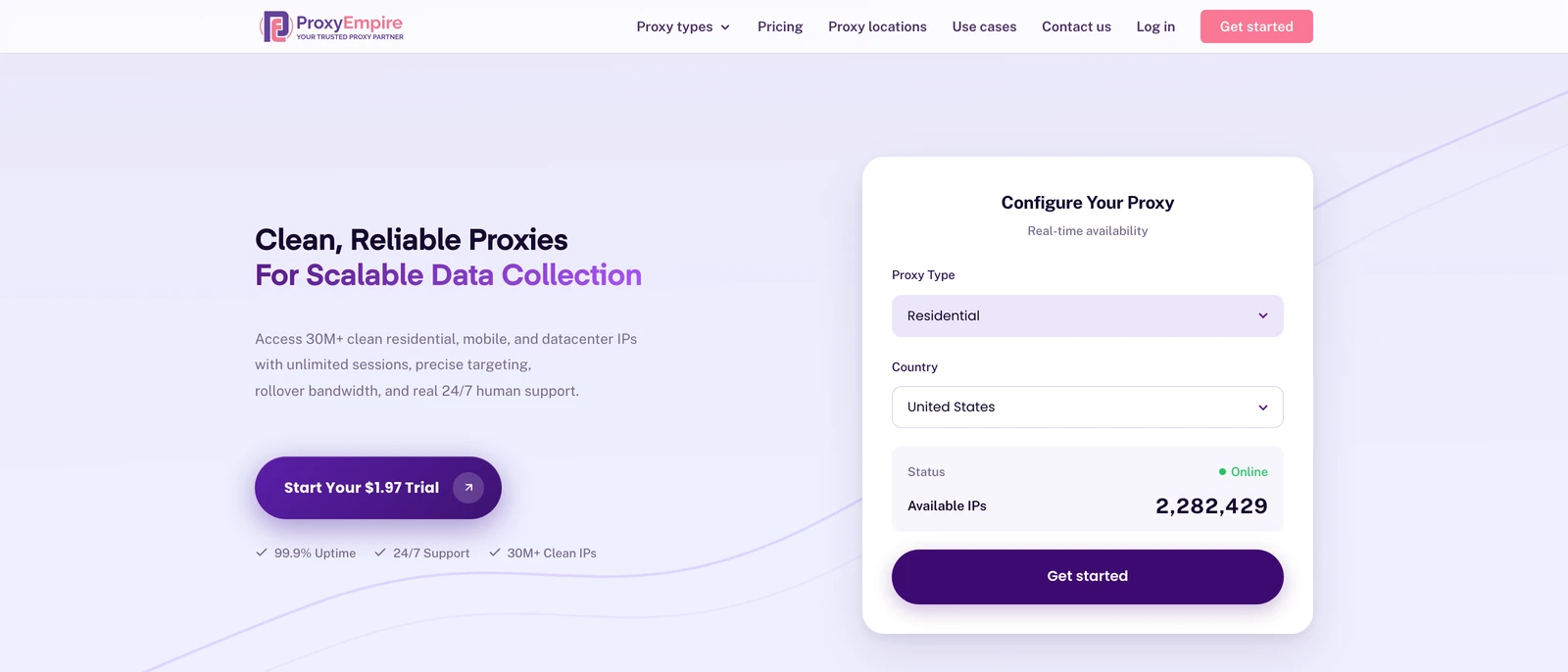
ProxyEmpire
Best overall in South KoreaProxyEmpire sells all four proxy products in South Korea and documents its coverage province by province and network by network.
- All 17 provinces and metropolitan cities and 172 locations, including 23 of Seoul’s 25 districts, on 15+ fixed-line networks from KT, SK Broadband and LG U+ to regional cable such as KCTV Jeju
- Mobile IPs on SK Telecom, KT and LG U+, with ZIP, ASN and OS fingerprint targeting at no extra charge; bandwidth rolls over and sticky sessions have no time limit
- 24/7 support from real people, not a bot or a ticket queue that reopens in the morning — uncommon at this price
- Datacenter and static IPs are targeted at country level only; province, city, ISP and carrier targeting applies to residential and mobile

IPRoyal
Cities outside SeoulIPRoyal publishes the longest Korean city list of any competitor here, with around 80 city pages that reach well beyond the capital.
- Around 80 Korean city targets, from Seoul, Busan and Incheon down to smaller places such as Sokcho, Taebaek and Boryeong
- All four proxy types locally, including static ISP proxies for long-lived logins, and rotating residential traffic that does not expire
- IPRoyal claims 66,728 Korean IPs, fewer than most here, and it is one of the pricier options at realistic volumes — $4.55/GB at 100 GB and $3.36/GB at 1 TB; the $1.75/GB on its Korea page needs a 10 TB order
ResiProx
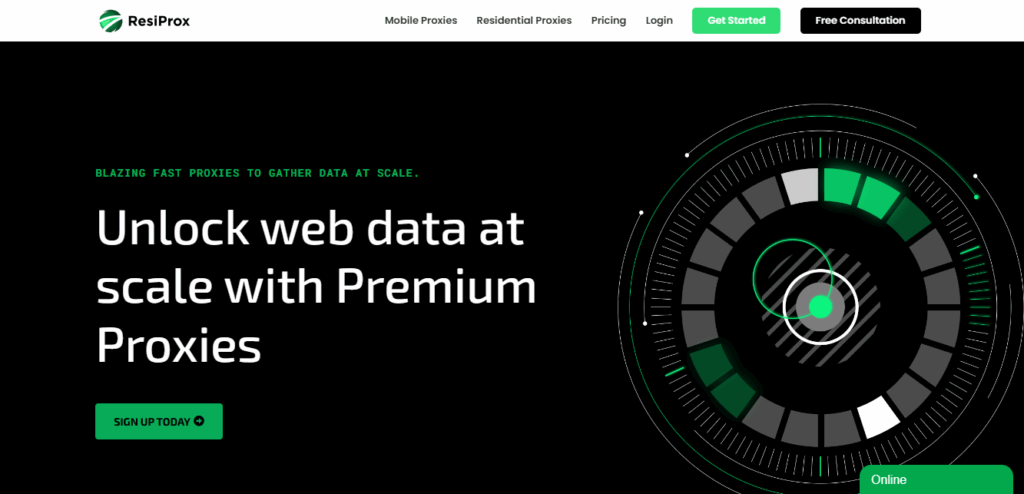
ISP targeting on a budgetResiProx includes ISP-level targeting on every plan from $3.50/GB, which matters in South Korea: arriving on a KT or SK Broadband line, not just “from Korea”, is what clears stricter local checks.
- Country, region, city and ISP targeting on every plan, claiming 1,885,184 South Korean IPs, with SK Telecom, KT and LG U+ named on its Korea page
- Starts at $3.50/GB and falls to $1.75/GB at 1 TB, with a $3.97 trial covering both residential and mobile
- Rotating proxies only — no static, ISP or datacenter IPs — and beyond Seoul, Busan, Incheon, Daegu and Gwangju no Korean city list is published

Oxylabs
Enterprise-scale scrapingOxylabs publishes the largest South Korea figure here, but says little about where inside the country those IPs sit.
- Headlines 2,421,601 IPs on its Korea page and lists 6,488 of them in Seoul, with state, city and ASN targeting
- Mobile proxies on 5G, 4G, 3G and LTE plus dedicated datacenter IPs, with strong support for large scraping jobs
- The page presents residential and datacenter IPs together, so that headline is not comparable with residential-only counts; Seoul is the only city with a figure, ISP proxies are not listed for Korea, and there is no pay-as-you-go
Proxy-Seller
Cheapest at 1 TBProxy-Seller sells the widest product range for South Korea — six categories — and the lowest per-GB residential rate here at 1 TB.
- The cheapest 1 TB rate here at $1.45/GB, with no coupon needed
- Six product categories from one account, and a stated 400 networks across 800 subnets for its dedicated Korean IPs
- It promises “city-level targeting across South Korea” but names no city, publishes no Korean IP count, and the per-IP prices on its locations pages are weekly rather than monthly rates
Byteful
Non-expiring trafficByteful, formerly Ping Proxies, sells all four proxy types for South Korea and publishes a Korean page quoting 43,889 monthly active IPs.
- Region, city, ISP, carrier and ASN targeting, and a claimed 35M+ residential IPs in 195+ countries
- Bandwidth never expires, and a 1 GB trial lets you test first
- Cities appear only in marketing copy, no local carrier is named, and its figure counts monthly active IPs, not a pool total
NodeMaven
IP-quality filteringNodeMaven screens every IP for quality before assigning it, and its location list rates South Korea “High”, its top availability badge.
- Every IP is screened before you get it, and unused traffic rolls over
- A current 20% discount brings it to $4.25 → $2.20/GB, and a $3.50 trial includes 750 MB
- No South Korea-specific pool size is published, and it lists 250K mobile IPs worldwide
SOAX
Carrier-level targetingSOAX lets you pin traffic to a region, city or mobile operator, useful when a Korean app should see an ordinary mobile subscriber.
- Region, city and carrier targeting, claiming 136,320 Korean IPs
- Credits roll over for 60 days, and the rate falls to $1.50/GB on the 1 TB plan
- The Korea page offers “the most popular network operators” but names neither a carrier nor a Korean city; datacenter is US-only, and a competitive rate means a $1,500 monthly subscription
Bright Data
ZIP-level targetingBright Data sells all four proxy types for South Korea and includes city, state and ZIP targeting free, which suits retail work where delivery area matters.
- Four proxy types with free city, state and ZIP targeting in South Korea
- A 50% coupon currently takes pay-as-you-go to $4.00/GB and the largest plan to $2.50/GB
- The highest regular pricing here at $8.00/GB, and it claims 76,917 Korean IPs — the 400M+ figures on the same page are global, not Korean — without naming a single Korean city
Webshare
Cheap datacenter IPsWebshare is built around low-cost datacenter proxies sold per IP, and it publishes a real South Korea page with a count.
- Datacenter proxies from about $0.018 per IP a month, the cheapest way here to get a Korean address for light work
- Claims 230,263 South Korean IPs and states country, city, state, ZIP and ASN targeting for rotating residential
- That count is not split by product, no Korean city is named, and the $1.40/GB on the page is the 3,000 GB rate; at 1 TB it is $1.50/GB on a $1,500 monthly plan
Infatica
Seoul’s satellite citiesInfatica names 12 Korean cities, several of them the large Gyeonggi cities around Seoul.
- Named targets include Suwon, Goyang, Seongnam, Bucheon and Ansan alongside Seoul, Busan, Incheon and Daegu
- Four proxy types plus an IPv6 residential option, with country, city and ZIP targeting and a $4.00 trial
- It claims only 5,000+ Korean IPs, the smallest figure here; the $2.60 rate needs 1,000 GB a month, and going lower requires annual billing
MarsProxies
Four proxy types in one planMarsProxies sells four proxy types for South Korea from a single balance.
- Four proxy types from one balance, city pages for Seoul, Busan, Incheon and Daegu, and non-expiring traffic
- Its 117,434 “South Korea proxy servers” are counted across datacenter, ISP and residential together, so the residential share is unknown
- The $1.65/GB advertised on the Korea page needs a 10,000 GB order — realistically it is $2.99/GB at 100 GB and $2.10/GB at 1 TB
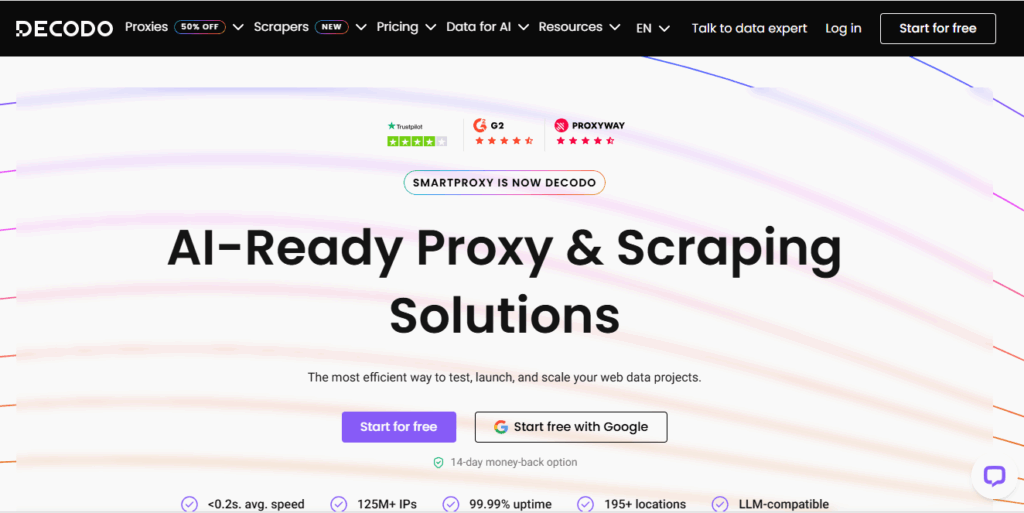
Decodo (formerly Smartproxy)
Pay-as-you-go residentialSmartproxy rebranded as Decodo in April 2025. Its Korea page covers residential proxies only.
- Pay-as-you-go from 1 GB and a clear ladder down to $2.00/GB at 1 TB
- Claims 58,199 Korean residential proxies, and its network-wide targeting goes down to city, ZIP and ASN
- The Korea page names no Korean city and no mobile, ISP or datacenter option, so anything beyond country-level residential has to be taken on trust

IPBurger
Monthly team plansIPBurger includes South Korea in its residential location list, sold on fixed monthly plans.
- Country and city targeting on every plan, with state, ISP and ASN filters from the Plus plan up
- South Korea gets no dedicated page, IP count or city list, unlike IPBurger’s largest markets
- Subscription only and the highest per-GB price here — $5.90/GB at 10 GB, $4.48/GB at 60 GB — with nothing above 60 GB published
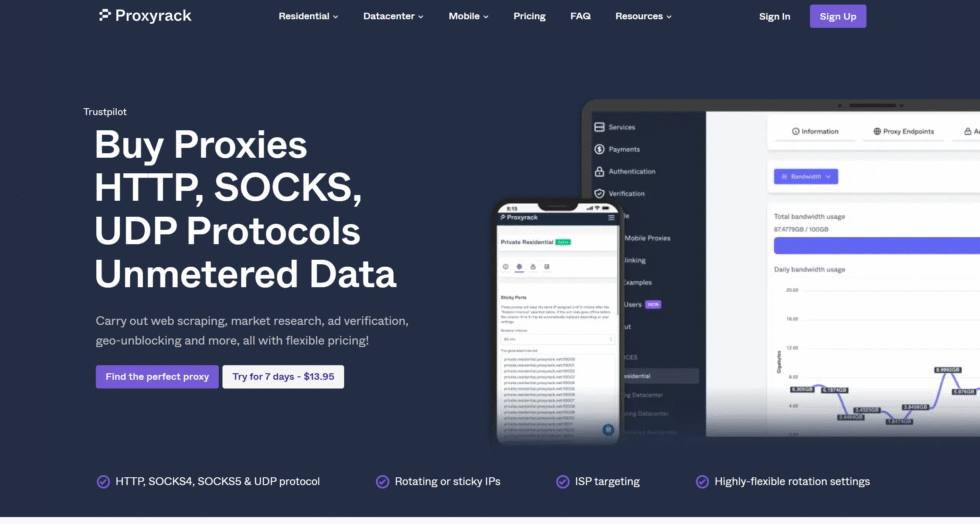
ProxyRack
High-volume residentialProxyRack has the lowest per-GB rates here, but only if you commit to a large volume up front, and it publishes almost nothing about South Korea.
- $1.10/GB at 100 GB falling to $0.80/GB at 500 GB — the cheapest residential rates here by a clear margin
- The entry plan is 100 GB at $110 a month with no pay-as-you-go, and South Korea appears only as a line in a country list — no page, no IP count, no targeting detail
Which type of South Korea proxy do you need?
Match the proxy to the job| Residential | Mobile | Static residential | Datacenter | |
|---|---|---|---|---|
| IP source | Korean home fibre and cable | SK Telecom, KT and LG U+ SIMs | ISP-registered, held long term | Server IPs |
| Rotation | Rotating or sticky | Rotating or sticky | Fixed | Rotating or sticky |
| Targeting | Province, city, ZIP, ISP | Province, city, carrier | Country | Country |
| Block risk | Low | Lowest | Low | Higher |
| Typical price | $1.50–$4/GB | $2–$4.50/GB | From $2/IP a month | From $0.35/GB |
| Best for | Scraping, prices, SERPs, ads | Social media, apps, strict anti-bot sites | Long-lived accounts and logins | Bulk, speed-sensitive work |
All four are available from ProxyEmpire’s South Korea proxies on one account. Nearby, there are pages for Japan, Taiwan and Hong Kong.
Why avoid a free Korean proxy?
Free usually costs moreFree Korea proxy lists and web proxies such as CroxyProxy are fine for glancing at one page, not for real work. Public servers are shared, already blocked on Naver, Coupang, Gmarket and Google.co.kr, and gone within hours; their operators can log or alter your traffic, and none lets you choose a province, city, ISP or carrier. For a CroxyProxy alternative that behaves like a real Korean visitor, use a paid residential proxy with a cheap trial.
South Korea at a glance
Why Korean IPs matter- Population: about 51.12 million registered residents at the end of 2025, mostly in large cities — which is why city targeting matters.
- Local administration: 17 first-level areas: Seoul, six metropolitan cities, Sejong, six provinces, and Jeju, Gangwon and Jeonbuk.
- Currency: the South Korean won (KRW), issued by the Bank of Korea; only a Korean IP reliably shows local prices.
- Internet use: 95.0% of people aged 3 and over in 2025.
- Online shopping: ₩272.0 trillion in 2025, a record, with 77.6% of it on mobile.
- Mobile networks: three national operators — SK Telecom, KT and LG U+ — with about 10.49 million budget (MVNO) phone lines from 59 operators running on those same three networks as of June 2026.
Sources: Ministry of the Interior and Safety (resident registration population, Statistical Yearbook 2026; local administration); Bank of Korea (currency); Ministry of Science and ICT (2025 Survey on the Internet Usage; wireless subscriber statistics, June 2026); Ministry of Data and Statistics, formerly Statistics Korea (Online Shopping Trends, 2025).
Korean proxy FAQ
Straight answersWhat is the best Korean proxy service?
ProxyEmpire, in our 2026 comparison. It sells residential, mobile, datacenter and static IPs in South Korea and includes ISP, carrier, ZIP and ASN targeting at no extra cost.
What is a South Korea proxy server?
A South Korean proxy server routes your traffic through a Korean IP address, so websites treat you as a local visitor. A Korean proxy IP from home broadband or a SIM is much harder to block than a datacenter address.
Can I target a specific Korean city or province?
Yes. ProxyEmpire covers all 17 provinces and metropolitan cities and 172 locations, down to individual Seoul districts. IPRoyal lists around 80 cities, Infatica names 12, ResiProx five and MarsProxies four; most of the others offer city targeting without naming any Korean city.
Which South Korea proxy is the cheapest?
ProxyRack is cheapest on paper at $1.10/GB falling to $0.80/GB, but needs a 100 GB plan up front. Proxy-Seller reaches $1.45/GB at 1 TB. ProxyEmpire starts at $1.50/GB and is the only one of the three including city, ISP, carrier and ASN targeting at no extra charge.
Are there Korean mobile proxies?
Yes. ProxyEmpire offers mobile IPs on SK Telecom, KT and LG U+, the three national networks that budget MVNO brands also run on. ResiProx, SOAX, Oxylabs, Bright Data, IPRoyal, MarsProxies, Infatica and Proxy-Seller also sell Korean mobile proxies.
Can I get a static or datacenter Korean IP?
Yes. ProxyEmpire sells both in South Korea: static residential from $2.00 per IP a month, which keeps one address for long-lived logins, and datacenter from $0.35/GB.
Why do the published South Korea pool sizes vary so much?
They are self-reported and counted differently — from 5,000+ to 2,421,601 here, and some mix in datacenter IPs. Treat every pool number as a claim and judge on documented targeting.
Is it legal to use a proxy in South Korea?
Yes. What matters is how you use one: respect websites’ terms of service, and follow South Korea’s Personal Information Protection Act when you collect or process personal data.
Get Korean IPs in minutes
Residential, mobile, datacenter and static IPs across all 17 provinces and metropolitan cities and 172 locations, with city, ISP and carrier targeting included, bandwidth that rolls over and 24/7 support from real people.