













Static Residential Proxies – Buy Static Residential Proxies (ISP) in over 21 countries
ProxyEmpire’s ISP Proxy service allows you to keep using the same residential IPs for a month or longer.
Buy your own dedicated static residential IP and never get blocked again.

Harness the Power of Static Residential Proxies
Tired of constantly rotating IPs? Static residential proxies give you total control with the same private, targeted IPs for all your web data needs.
What Are Static Residential Proxies?
Static residential proxies use IP addresses from ISPs that remain fixed instead of rotating randomly. They are allocated to a specific residential device like a home internet connection.
Benefits of Static Residential Proxies
- IP consistency: Keep using the same IPs for ongoing access to target sites.
- Avoid frequent re-authentication: Maintain persistent sessions without constant logins.
- Stickiness emulates real users: Static IPs mimic actual user behavior better than rotating.
- ISP-level targeting: Filter proxies by specific ISP carriers or networkss.
- Resist blocking: Residential IPs are less likely to get flagged than datacenters.
Use Cases for Static Proxies
- Managing accounts long-term: Keep all your social media and marketplace accounts unified.
- Consistently accessing geo-restricted content: Ongoing access to streaming sites and services.
- Price monitoring: Check pricing pages from the same IPs to avoid re-authentication.
- SEO analytics: Sticky IPs ease rank tracking and content analysis for sites prone to blocking.
- Data aggregation: Gather data over time by mimicking normal user browsing behavior.
Static Residential Proxies in Automation Workflows
Static residential proxies maintain consistent IP addresses during extended sessions, which suits tasks that demand uninterrupted connections in automation setups. When projects involve frequent IP rotations for diverse data collection, rotating residential proxies offer the adaptability needed for such dynamic environments. In automation, these proxies integrate with various tools to handle repetitive processes efficiently.
Users often incorporate static residential proxies alongside rotating mobile proxies in workflows where mobile network simulation is required for testing applications. For scenarios demanding dedicated connections from specific carriers, dedicated mobile proxies provide the stability for long-running automations. Automation in data aggregation frequently benefits from understanding foundational techniques outlined in web scraping basics.In complex automation chains, combining static residential proxies with rotating datacenter proxies allows for handling high-volume requests without compromising speed.

Choosing the Best Static Proxy Provider
Look for providers with:
- Millions of residential IP choices: Enough to find optimal static IPs that avoid blocks.
- Numerous ISP options: Ability to filter proxies by specific ISP sources.
- Flexible assignment times: Options for IP assignments from a few hours to months.
- Targeting controls: Filters to geo-target locations to your needs.
- Quality IP testing: Ensures assigned IPs maintain reliability over time.
With millions of targeted, high-quality static residential proxies, ProxyEmpire has your data needs covered. Sign up today!
ProxyEmpire – Best Static Residential Proxies In 2025
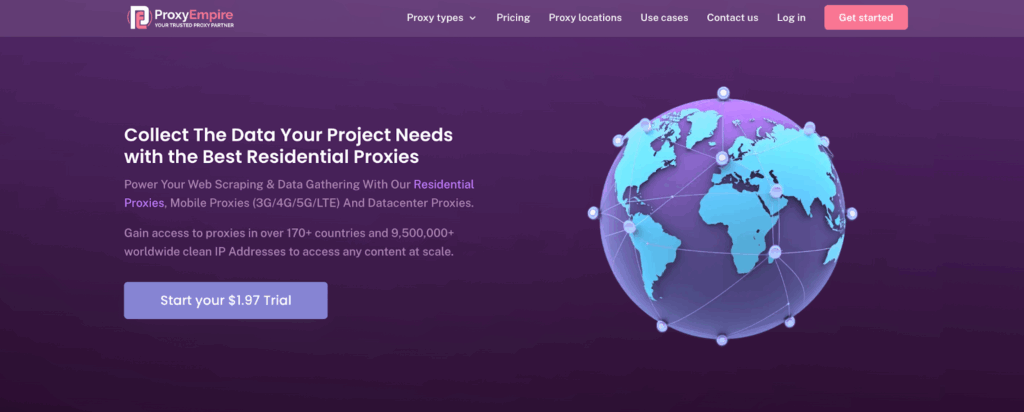
ProxyEmpire is a premium proxy service provider designed to empower web scraping, data collection, and unrestricted internet access through a vast network of ethically sourced residential, mobile, and datacenter proxies. Below is a detailed description based on the provided information:
Overview of ProxyEmpire
ProxyEmpire offers a comprehensive suite of proxy solutions tailored for individuals, businesses, and developers seeking reliable, high-performance tools for data gathering and privacy protection. With over 30 million clean IP addresses spanning 170+ countries, ProxyEmpire provides unparalleled global coverage, ensuring users can access content at scale with a 99.9% uptime and lightning-fast response times (as low as 0.6 seconds).
Proxy Types and Features:
🏘️ Rotating Residential Proxies
Key Benefits
- Global Reach: Access to over 30 million IPs worldwide, covering every major region, with precise targeting options (country, city, state, ASN/ISP).
- High Reliability: A 99.86% uptime ensures uninterrupted service, supported by patented technology for enhanced speed and security.
- Ethical Sourcing: Proxies are responsibly harvested, ensuring quality and compliance.
- Versatile Use Cases: Supports web scraping, price monitoring, sneaker copping, SEO tracking, ad verification, and more.
- Integration-Friendly: Compatible with standard proxy protocols (HTTP, SOCKS5) and third-party tools like Multilogin, Dolphin Anty, Kameleo, Octobrowser, and Gologin.
- No Hidden Fees: Transparent pricing with all features included, starting at a $1.97 trial.
Use case:
Static Residential Proxies In 21 Countries.
We currently offer ISP proxies in the following countries:
United States, United Kingdom, Canada, Austria, Australia, Czech Republic, Netherlands, Germany, Greece, France, Denmark, Spain, Italy, Poland, Sweden, Brazil, Japan, Singapore, Luxembourg, Belgium, and Switzerland.
All of our static residential proxy plans come with personalized integration support to get you set up in minutes. Our proxies support both HTTP and SOCKS5 protocols and can be integrated in any software stack that supports user and password proxy authentication.
Our static residential proxies currently support only country targeting.
If you are interested in a larger number of non-static IPs check out our rotating residential proxy service. Our rotating residential and mobile proxies support Country, Region, ISP, and City targeting.
Need Help? Visit Our Blog For Advanced Web Scraping & Data Guides.
Static Residential Proxies
ProxyEmpire gives you access to a robust infrastructure of static residential proxies that work well with use cases where you need to keep the same IP accross all of our browsing sessions.
Static Residential IP Proxies allow you to keep the same exact IP address for a month, or longer, and they are exclusive to you.
We currently offer coverage across 17 different countries and 21 different internet service providers (ISPs).
Get Full Access To All Of Our Static Residential Proxies.
Buy as many Dedicated static residential IPs and the amount of bandwidth that you would like to use on them.
Get Started With Our $1.97 Trial Today
Final Word
This article focuses on ProxyEmpire’s Static Residential Proxies offering. These are proxies that use IP addresses from Internet Service Providers (ISPs) that are stationary rather than randomly rotating. The main advantage of static residential proxies is they emulate real user behavior, maintain persistent sessions without constant logins, and resist blocking.
Static Residential Proxies are an ideal solution for managing long-term accounts, accessing geo-restricted content persistently, price monitoring, SEO analytics, and data aggregation. This service provides Static Residential Proxies in 21 countries, personalized integration support, and supports HTTP and SOCKS5 protocols.
Additionally, ProxyEmpire offers options for IP assignments from a few hours to months and quality IP testing to ensure reliability over time. The service targets aspects such as country, region, ISP, and city. For those needing more non-static IPs, they also offer rotating residential proxy and mobile proxy services. Sign up for ProxyEmpire’s robust infrastructure of high-quality static residential proxies that provide optimum data solutions.
2026 Statistics and Trends
The use of static residential proxies has seen significant growth in 2024, driven by various factors including enhanced security needs, increased e-commerce activities, and the rise of data-driven business strategies.
| Metric | Value |
| Market Growth Rate | 11.48% CAGR |
| Reduction in Detection Risk | 45% compared to datacenter IPs |
| Improvement in Data Collection Efficiency | 45% |
| Increase in Operational Efficiency | 30% for data-heavy tasks |
| Improvement in Business Scalability | 40% of companies reported better scalability |
Static Residential Proxies for AI Training and LLM Data Collection
Static residential proxies give AI teams a fixed residential IP that stays the same across long training runs and repeated data pulls. Many model builders need the same identity when they gather public web pages for fine-tuning or when they check how an LLM answers the same prompt over days. A consistent IP keeps session state intact so the collection process does not reset mid-pipeline.
Teams that collect public datasets often combine a stable static residential IP with rotating residential proxies for the high-volume parts of the job. The fixed IP handles login-style or multi-step flows while the rotating pool covers bulk page fetches. This mix supports clean, repeatable data pipelines for language models without forcing every request through the same address.
In practice, the fixed residential address works well for tasks that build knowledge graphs or that sample the same public pages at regular intervals. Researchers can return to the same network path and receive consistent responses from the target site. When the project also needs mobile carrier traffic, rotating mobile proxies can sit beside the static residential layer so the overall setup covers both desktop and mobile views of public content.
Use Cases in Ad Verification, Market Research, E-commerce & Cybersecurity
Ad verification teams rely on a steady residential IP to view the same creative and landing page over multiple checks. The fixed address lets them confirm that ads render correctly from a real home network and that the experience stays the same across repeated visits. Projects that focus on this work often draw on the dedicated resources described under proxies for ad verification.
Market research groups use the same stable residential identity when they track public product pages, review sentiment, or sample local search results over weeks. Because the IP does not change, the data set stays coherent and easier to compare across time. Many of these projects also pull in SEO monitoring workflows so the research covers both marketplace and search visibility in one continuous view.
E-commerce monitoring benefits from a fixed residential path when teams watch inventory levels or public pricing pages that personalize based on the visitor’s network. A consistent IP reduces noise in the collected signals and keeps the observation window reliable.
Cybersecurity and brand-protection work uses the same long-lived residential IP to test public endpoints, watch for counterfeit listings, or review how a site responds from a trusted home network. The stable session supports repeated inspection without the identity shifting underneath the test. Teams that run these checks often pair the static residential layer with brand protection processes. Social media-related checks can also incorporate social media proxies when public profile or post monitoring is required.
Key Developments in 2026
- Enhanced Security Features: Static residential proxies have integrated advanced cybersecurity measures, including built-in firewalls and end-to-end encryption, to counter the rising threats of data breaches and cyber-attacks.
- AI and Machine Learning Integration: Providers have begun incorporating AI-powered systems to improve proxy performance, predict IP blocking, and enhance overall efficiency.
- 5G Adoption: The rollout of 5G networks has led to faster, more reliable static residential proxies, significantly reducing latency and improving performance for high-bandwidth tasks.
- Increased Use in E-commerce: More e-commerce businesses have adopted static residential proxies for tasks such as competitor price monitoring, ad verification, and accessing geo-restricted content.
- Expansion of IP Pools: Providers have significantly expanded their pools of static residential IPs, offering users more options and better geographic coverage.
Outlook for 2026
Looking ahead to 2026, several trends are expected to shape the static residential proxy landscape:
- Regulatory Compliance: Stricter data protection laws and increased scrutiny of proxy usage are anticipated, leading to more emphasis on ethical sourcing of IPs and transparent operations.
- IoT Integration: As the Internet of Things (IoT) expands, static residential proxies are expected to play a crucial role in managing and securing connections for smart devices.
- Advanced Geotargeting: Improvements in geolocation technology will likely enable more precise targeting capabilities, allowing users to access hyper-local content and data.
- Blockchain Integration: Some providers may explore blockchain technology to enhance the security and transparency of their proxy networks.
- Customization and Flexibility: There will likely be a trend towards more customizable proxy solutions, allowing users to tailor their proxy setups to specific needs and use cases.
- Focus on Sustainability: As digital infrastructure grows, there may be increased attention on the energy efficiency and environmental impact of proxy networks.
The static residential proxy market is poised for continued growth and innovation in 2025, driven by technological advancements and evolving user needs. As businesses and individuals increasingly rely on these proxies for various online activities, we can expect to see further developments in security, performance, and functionality.
Latest News In 2026
In 2026, many data teams place greater weight on session continuity when they build AI training sets. Fixed residential IPs have become a standard part of pipelines that revisit the same public pages over multiple days so the collected material remains coherent.
Developers who manage long-running LLM evaluation loops now keep a static residential address for the identity layer while they still draw volume traffic from other pools. This pattern appears across public-data projects that need both stability and scale. Some of these workflows also incorporate unlimited bandwidth residential proxies when traffic volume stays high for extended periods.
Browser-profile tools and automation frameworks continue to add native support for fixed residential endpoints, making it simpler to keep one clean network path across QA cycles and research sessions.
Market-research groups also report that consistent residential identities help them maintain clean time-series data when they sample public storefronts and search results week after week. Parallel work that needs faster bulk collection sometimes adds rotating datacenter proxies for the less sensitive portions of the same project.
FAQ
What are static residential proxies?
Static residential proxies involve IP addresses sourced from internet service providers and assigned to real devices, remaining unchanged for extended periods such as a month or more. These proxies maintain consistency in online sessions, which is useful in scenarios where repeated access to the same resources occurs without the need for reconfiguration. For applications needing varied IP rotations instead, rotating residential proxies offer an alternative approach in situations that demand frequent address changes.
How do static residential proxies differ from other types?
Static residential proxies provide fixed IPs unlike options that cycle through addresses, ensuring steady connections over time. This stability suits tasks requiring ongoing access, while rotating datacenter proxies serve budget-conscious setups in environments focused on basic data retrieval with periodic IP shifts. Similarly, dedicated mobile proxies deliver exclusive access via mobile networks in cases where device-specific emulation is involved.
What protocols do static residential proxies support?
Static residential proxies typically handle HTTP and SOCKS5 protocols, allowing compatibility with a range of software and applications. Authentication often occurs through username and password methods, facilitating integration into existing workflows. When automation for data extraction is part of the process, web scraping API integrates smoothly in setups requiring structured data handling alongside proxy usage.
In what situations are static residential proxies commonly used?
Static residential proxies appear in contexts like managing accounts on platforms over long durations or monitoring market data without session breaks. They align with needs for persistent IP presence, whereas rotating mobile proxies fit mobile network simulations in dynamic online activities. For specialized data gathering from search results, SERP scraping API complements such proxies in research-oriented tasks.
How does IP assignment work with static residential proxies?
IP assignment in static residential proxies ties addresses to specific durations, often renewable, ensuring the same IP persists across sessions. This setup avoids disruptions from changes, differing from rotating models. In e-commerce data scenarios, ecommerce scraping API pairs well with these proxies for consistent product information retrieval.
What makes static residential proxies reliable for online tasks?
The reliability stems from their origin in legitimate ISP networks, reducing detection risks compared to non-residential alternatives. They support unlimited concurrent connections, aiding multi-threaded operations. For social platform data collection, social media scraping API enhances functionality in environments using static IPs for extended monitoring.
Can static residential proxies integrate with various tools?
Yes, static residential proxies integrate with browsers, scripts, and automation tools via standard configurations. This flexibility extends to custom setups, where compatibility with APIs streamlines processes. Exploring all locations available helps in understanding coverage options when planning integrations.
What considerations arise when selecting static residential proxies?
Key factors include the duration of IP leases and protocol support, ensuring alignment with specific requirements. Comparing features across proxy types, as seen in proxy service comparison, provides insights into how static options stack up in different use cases.
How do static residential proxies handle bandwidth?
Bandwidth in static residential proxies often rolls over unused portions to subsequent periods, supporting continuous usage without strict limits. This model accommodates data-intensive activities, distinguishing it from capped alternatives.
What future trends affect static residential proxies?
Trends point toward enhanced integration with AI-driven tools and improved sustainability in IP management, influencing how these proxies evolve for emerging digital needs.
How do static residential proxies help with repeated public data pulls for AI models?
A fixed residential proxy IP creates a stable network identity that stays constant while an AI pipeline revisits the same public pages across multiple collection cycles. This consistency reduces unexpected variation in page responses that can appear when the exit address keeps changing. Researchers can therefore build cleaner training sets that reflect the true public state of a site rather than artifacts caused by shifting network paths. The same stable address also simplifies debugging when a particular data sample needs to be re-checked days later. Many pipelines place this fixed layer alongside higher-volume sources so the overall system balances identity needs with scale.
What role do fixed residential IPs play in multi-step QA testing?
Fixed residential proxies keep the same network identity active while a tester moves through multi-page flows, form submissions, or sequential checks. Session cookies and temporary state remain tied to one address, which prevents the test environment from resetting between steps. This is especially useful for localization and experience checks that must stay realistic across an entire user journey. Teams can return to an incomplete test the next day and continue from the exact same network perspective.
Can static residential proxies sit next to rotating pools in the same project?
Yes. Many projects assign the static residential address to phases that require a lasting identity and route the high-volume public fetches through rotating residential proxies or rotating mobile proxies. The fixed IP handles login-style steps, repeated verification, or long observation windows, while the rotating pool covers bulk sampling. This hybrid layout lets teams match the right network behavior to each part of the workflow without forcing every request into a single mode. The result is a more flexible data collection system that stays efficient across both stable and variable needs.
Which protocols work with static residential proxies in everyday scripts?
HTTP proxy, HTTPS proxy, and SOCKS5 proxy are the protocols most often used with static residential proxies in scripts and automation tools. These standards are already supported by common libraries in Python, Node.js, and other languages, so connection setup stays straightforward. Browser automation frameworks and anti-detect tools also accept the same protocols when they route traffic through a fixed residential address. The wide protocol support means teams can keep existing scripts and simply point them at the static residential endpoint.
How do static residential proxies support brand-protection monitoring over weeks?
A fixed residential IP lets monitoring systems return to the same public listings and pages on a regular schedule while appearing as a consistent home network. This stable viewpoint makes it easier to notice gradual changes such as new counterfeit offers or altered product pages that might be missed under rotating proxy addresses. The long-lived identity also supports side-by-side comparison of the same URL across days or weeks without introducing network-related noise.
